HEVC Advance patent pool: Rising SEP litigation and strategic licensing risks

Catherine Bonner

Aaron Lucas

Xiaoyao Yin

The recent wave of litigation around the HEVC Advance patent pool serves as a reminder of the importance of strategic SEP licensing.
Understanding HEVC and SEP pool licensing
Technology licensing enables a licensee to access patented technology that is otherwise exclusively used by the licensor in exchange for a licensing fee. Patent pools enable access to multiple essential patents crucial for product development and manufacturing through a single licence, making IP compliance simpler and less time consuming.
Patent pools are crucial to sectors which depend on standardised technologies, particularly within the telecommunications and audiovisual industries. Some popular patent pools include HEVC (High Efficiency Video Coding) Advance, Avanci 4G Vehicle, and AV1.
Operated by the independent licensing administration company Access Advance, the HEVC Advance Patent Pool focuses on patents essential to the High Efficiency Video Coding technology standards, HEVC/H.265, as administered by the International Telecommunication Union. HEVC is important in high-quality video communication, streaming, and broadcasting.
The FRAND debate behind HEVC licensing
Licensors of the HEVC Advance Patent Pool include some of the biggest key players in the mobile, PC, and TV industry, such as Samsung, Huawei, Sony, Nokia, and Google. Licensors agree to offer their patents on FRAND terms (Fair, Reasonable and Non-Discriminatory) in exchange for royalties.
Access Advance applies different royalty rates by product categories and seeks to be paid one royalty per device/software copy on First Sale. As shown in the Figure below, the royalty rate is € 0.4 / £0.35 (for Region 1) per device for mobile devices, including phones, tablets, and laptops, across all price ranges. By contrast, for Connected Home & Other devices, including game consoles and desktop PCs, the rate varies according to the product’s selling price. This raises a contested question: is it fair and reasonable for someone selling a phone for £100 to pay the same royalty rate as someone selling a laptop for £2,000?
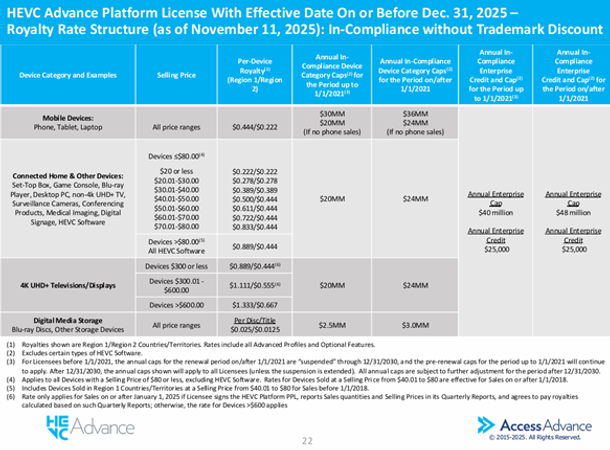
Unsurprisingly, whether the offered licensing terms are indeed FRAND is sometimes disputed.
The growing HEVC litigation trend
The latest litigation pattern suggests that HEVC licensing disputes are becoming increasingly coordinated and multi-jurisdictional.
In the past year alone, big names like ASUS, ACER, Hisense, Meta, and Disney have faced infringement actions from licensors of the HEVC patent pool.
In 2025, Acer, ASUS and Hisense were sued by Nokia over video patents in the Unified Patent Court (UPC), Germany, the United States, Brazil and India. In response to the infringement proceedings, those three companies have filed FRAND actions against Nokia in the High Court of Justice for England & Wales (EWHC), arguing that the licensing terms proposed by Nokia are not fair or reasonable.
Although the UK High Court has since granted the trio interim licences, German courts issued injunctions against Acer and ASUS in January this year, leading to sales suspensions in Germany. Meanwhile, Hisense has reached a licensing agreement with Nokia.
In January 2026, Huawei sued Disney in the Mannheim Local Division of the UPC over EP3211897, which relates to video codec and is part of the HEVC patent pool, and in March 2026, it launched further actions against Meta at the same court and in Brazil over EP3471419, another patent in the HEVC pool.
This growing litigation trend is suggesting that the patent pool is not merely an administrative framework for collecting royalties, but also part of a broader enforcement strategy in which individual licensors may pursue direct litigation to encourage potential licensees to settle bilaterally or to take a licence.
We will continue to monitor developments in this area.
The UPC and the rise of multi-forum SEP litigation
The Unified Patent Court (UPC) is a specialised court created to handle disputes related to European patents. The UPC was designed to simplify and unify patent litigation across participating European Union member states and came into force on 1 June 2023.
The Unified Patent Court (UPC) is also being used increasingly in SEP disputes.
The UPC offers patent owners the prospect of streamlining the litigation process and ensuring more uniform decisions across multiple participating states, which can increase settlement pressure. That makes the UPC an attractive forum for SEP licensing disputes, particularly where the objective is to make the defendant take a licence rather than merely to recover damages for past acts.
At the same time, SEP disputes often run in parallel with actions in other jurisdictions, including Brazil and German national courts. This multi-forum approach can significantly affect negotiations: the parties are not dealing with a single claim in isolation, but with a broader enforcement and defence landscape that may involve different remedies and timelines across courts.
For potential licensees, it increases the need for a coherent cross-jurisdictional FRAND strategy. For licensors, it creates opportunities but also risks, particularly where conduct in one forum may be scrutinised in another as part of the broader FRAND narrative. The current HEVC litigation pattern reflects exactly that kind of strategic forum use.
After Unwired Planet v. Huawei, the UK also retains its distinctive role as a leading forum for setting global FRAND rates and granting interim licences. Interim licences are a remedy that is mostly undeveloped outside of the UK. Defendants who are granted interim licences can avoid business disruption by paying claimants some royalties while the final FRAND terms are determined.
Overall, SEP disputes are increasingly shaped by a combination of multi-jurisdictional enforcement pressure and English FRAND jurisdiction.
Strategic considerations for licensors and licensees
The broader takeaway is that a SEP pool does not eliminate dispute risk; it concentrates key issues into a more structured, yet still contested, licensing framework.
For potential licensees, the main considerations include whether the pool gives sufficient coverage, whether duplicate royalty concerns are properly addressed, whether the offered terms are FRAND, and how to respond if pool participants litigate individually. For patent licensors, the SEP pool offers efficiency, scale and a coordinated route to revenues, but it does not remove the need for careful FRAND conduct.
In summary, the current HEVC disputes underline a key point: licensing efficiency and legal certainty are not equivalent. A SEP pool can simplify access to a standard by centralising licensing, but where there is disagreement over scope or valuation, legal uncertainty persists, and negotiation or litigation is ultimately needed.
This is an area of ongoing development, and we will explore related issues further in future articles.
If you would like to discuss SEP licensing strategy or FRAND disputes further, please get in touch with our team.
Meet the authors

About Catherine Bonner

About Aaron Lucas

About Xiaoyao Yin
Related insights
Featured insight

Key themes from the IPO Annual Meeting 2026: AI, accountability and digital designs
- Read article
Patent Box take-up: What has changed since the beginning?
- Read article
The power of strategic partnerships in AI: Key IP considerations
- Read article
Patent Box relief passes £2 billion as take-up continues to grow
- Read article
Carry-over auxiliary requests in EPO appeals: Why early procedural planning can protect commercial value
- Read article
Filed, published & granted patents: What’s the difference?