The importance of intellectual property in economic success for SMEs

Barry Moore

The recently published "Intellectual Property Rights and Firm Performance in the European Union" (2025) study from the European Union Intellectual Property Office (EUIPO) and European Patent Office (EPO), explores the impact of intellectual property rights (IPRs) on the economic performance of firms across the European Union.
A significant study not only in the conclusions, but also the scale of the analysis which was built on utilising a comprehensive dataset of over 119,000 firms from 2013 to 2022.
The authors conclude that IPR ownership correlates with enhanced firm performance, particularly in terms of revenue per employee. SMEs show the most significant performance improvements, with IPR owners achieving 44% higher revenue per employee compared to non-owners. The study further examines the types of IPRs and their combinations, revealing that firms leveraging bundles of patents, trade marks, and designs exhibit the highest performance premiums. These findings highlight the critical role of IPRs in fostering innovation, productivity, and competitive advantage, emphasising the need for policies that enhance IPR accessibility, particularly for SMEs.
Previous Studies on the Matter
This study is not the first collaborative research conducted by the European Patent Office (EPO) and the European Union Intellectual Property Office (EUIPO). An earlier report, High-Growth Firms and Intellectual Property Rights" (2019) investigated the relationship between intellectual property rights (IPRs) and the growth prospects of small and medium-sized enterprises (SMEs) in Europe. It reported how high-growth firms (HGFs), which constitute a small fraction of SMEs, contribute disproportionately to employment and turnover growth. The study revealed that SMEs with prior IPR activities are significantly more likely to experience high growth, with patent and trade mark filings serving as strong predictors of success. It also highlighted the strategic use of IPR bundles in enhancing growth potential, with European-level filings indicating a readiness for business expansion across the EU. These insights underscore the importance of supporting SMEs in accessing and leveraging IPRs to drive innovation and economic growth.
Each of these two documents are important reviews in their own right, but it is useful to compare the key observations from both reports to evaluate what, if any, are comparable findings.
IPR Ownership and Economic Performance:
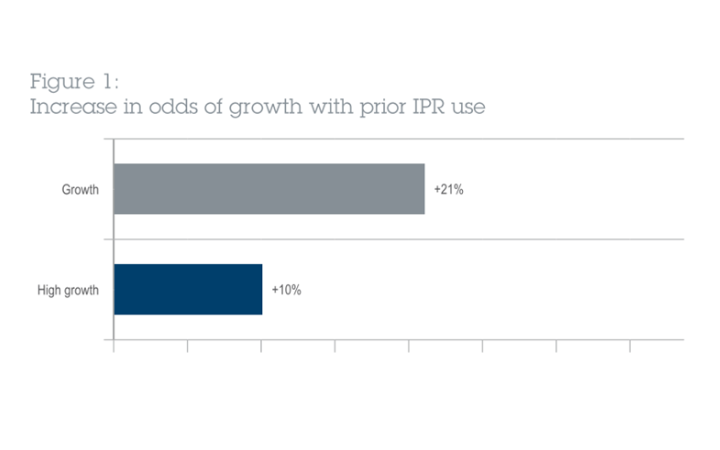
Both reports emphasise that firms owning intellectual property rights (IPRs) tend to perform better economically. The "High Growth Firms" study from 2019 highlights that SMEs with prior IPR activity are more likely to experience growth, with a 21% higher likelihood of growth and a 10% higher likelihood of becoming high-growth firms (HGFs). Similarly, the 2025 "IPR and Firm Performance" report finds that IPR owners have 41% higher revenue per employee compared to non-owners.
It appears conclusive: firms that have an awareness of and invest in securing IPRs will ultimately do better.
Impact on SMEs:
Each report usefully investigates whether this correlation between the ownership of IPRs and commercial success has any specific impact on small to medium size enterprises (SMEs). This is important, as it is often these types of organisations that struggle in creating an awareness of the benefit of IPRs, but are also challenged in justifying the cost of investing in IPRs verses any potential benefit.
What can be demonstrated for business owners and advisers is that a significant correlation is seen in both reports regarding the impact of IPR on small and medium-sized enterprises (SMEs). The 2019 study points out that HGFs, many of which are SMEs, benefit significantly from IPRs as they enable them to secure better margins and attract investors. The 2025 report indicates that SMEs owning IPRs have 44% higher revenue per employee, showcasing the substantial benefit of IPRs in enhancing firm performance.
Sectoral Insights:
Whilst being, not surprisingly Euro-centric, the reports do look to highlight specific sectors where IPR ownership is prevalent and beneficial. The 2019 study notes the importance of patents in both high-tech and low-tech industries for predicting high growth, while the 2025 report identifies sectors like manufacturing and information and communications as having high IPR ownership rates, further showing that IPRs are particularly valuable in these areas.
IPR Bundles and Growth:
The famous quote by Abraham Maslow that if the only tool you have is a hammer, you tend to see every problem as a nail is reaffirmed here. Too often IP practitioners offer advice that is specific to their speciality- patent attorneys suggesting patents, trade mark attorneys suggesting trade marks. In the real world however, and as confirmed by both reports, there are advantages of owning multiple types of IPRs. The 2019 study shows that SMEs using bundles of IPRs are more likely to achieve high growth.
The 2025 report corroborates this, indicating that firms owning combinations of patents, trade marks, and designs have significantly higher revenue per employee. This suggests that a comprehensive and multi-faceted IP strategy can amplify commercial success, as useful take home for any external advisor.
IPRs as Growth Predictors:
It is also interesting to see that the predictive nature of IPRs in forecasting firm growth is a shared finding. The 2019 study finds that IPR activities can signal an SME’s potential for high growth, a notion supported by the 2025 report’s findings that IPR ownership correlates with higher economic performance. This conclusion reaffirms the notion that awareness of the importance of IP within a business plan and the implementation of steps to build a portfolio, particularly at early pre-significant-revenue stages, can lend to valuations that otherwise would not be justifiable. Anecdotally at least this conclusion is already known in America- with the phrase “corporate America loves patents” coming to mind. What the analytics from these reports appear to validate however is that the presence of an IP strategy within a company can be used as a positive indicator of value, both to attract and justify early stage investment.
Conclusion
Both the "High-Growth Firms and Intellectual Property Rights" (2019) and the "Intellectual Property Rights and Firm Performance in the European Union" (2025) studies underscore the pivotal role that intellectual property (IP) awareness and management play in the success and growth of firms, particularly small and medium-sized enterprises (SMEs).
The 2019 study highlights that SMEs with prior IPR activities are substantially more likely to achieve high growth, indicating that awareness and proactive engagement with IP systems can be a strong predictor of future success.
SMEs that have filed at least one IPR are 21% more likely to experience a subsequent growth period, and 10% more likely to become an HGF. The likelihood of experiencing a growth period is 9% higher for SMEs that have filed at least one patent, and 13% higher for those that have filed at least one trade mark.
Similarly, the 2025 analysis shows that IPR ownership correlates with higher revenue per employee, with SMEs benefiting the most from IP strategies.
Revenue per employee is 41% higher for IPR owners than for firms that do not register IPRs. This relationship is particularly pronounced for SMEs.
The data reveals that firms with active and strategic IP management are more likely to experience significant growth and improved economic performance. The answer to any question posed as to can I afford to invest in protecting my IP should be answered, you cannot afford not to.
With the 2025 report also concluding that most firms do not register IPRs, and if they do, they only register trade marks, it appears that the value of a comprehensive IP protection strategy has not yet been fully adopted by most. Companies, particularly those in the start-up phase need to be aware of these successes, that awareness will allow them to stop looking at IP protection as a cost, as opposed to an opportunity. Innovation without protection is not sustainable, the cost of the protection needs be factored into the R&D cycle....
If you are looking to understand more about intellectual property protection for your business, contact Murgitroyd. Whether you’re an SME at the beginning of your innovation journey, or a well-established company, our attorney teams have the expertise and understand to assist your business to help you to achieve your goals.
Meet the author

About Barry Moore
Related insights
Featured insight

Filed, published & granted patents: What’s the difference?
- Read article
What are trade secrets & how can they be protected?
- Read article
Right-sizing your patent portfolio: Maximising value through strategic portfolio management
- Read article
Why intellectual property matters to investors: IP due diligence and investment readiness
- Read article
EPO guidelines for examination: 2026 amendments & updates
- Read article
Battery recycling and reuse technologies drive patent growth