
The rise of beauty “dupes" has become a significant challenge for the cosmetics industry.
For decades, the primary threat to beauty brands came from illegal counterfeits; products that fraudulently use a brand’s name and logo to deceive consumers, and whilst the legal path against fakes is clear cut, the rise of the dupe poses more complex challenges.
The rise of beauty dupes and the enforcement challenge
Dupes are crafted to deliberately echo the look, feel, and branding elements of well-known companies and products, aiming to evoke a similar overall impression to the usually more expensive equivalent, while steering clear of overt IP infringement.
In recent years, beauty dupes have firmly stepped into the mainstream and are being spotlighted everywhere, from news outlets to dedicated advisory sites, social media channels, and influencers who have made it their whole niche to share these finds. In 2025, a study found that Charlotte Tilbury’s ‘Magic Cream’ ranks as the most sought-after product dupe, closely followed by Hailey Bieber’s Rhode ‘Glazing Milk’.
It is understandable why dupes are turning heads. On average, premium brand products are 347% more expensive than dupe alternatives, and so who wouldn’t be intrigued by the idea of owning a product that is allegedly as good, if not better, than the original at a fraction of the cost?
However, dupe products can have seriously damaging consequences for brands, in particular, the dilution of a brand's identity, exploitation of its reputation, a reduction in sales, and loss of customer loyalty. For any beauty business, understanding the legal landscape and available protective measures is no longer just an option, but a necessity.
Why lookalikes remain difficult to stop
Historically, preventing lookalike products has not been straightforward, with brands often relying on the law of passing off, where claimants are required to demonstrate three elements: goodwill, a misrepresentation resulting in deception (or likelihood of) and resulting damage.
Passing off claims can be evidence-heavy, time-consuming and expensive, particularly as dupes are presented in a way that creates a very close resemblance to the original, whilst avoiding the distinctive and original branding elements, such as names and logos. In this situation, it can be difficult to prove that prospective customers will mistakenly believe that the lookalike product is actually the original.
In addition to passing off, brand owners may also rely on trade mark infringement under the Trade Marks Act 1994. However, succeeding under section 10(2), which requires proof of a likelihood of confusion, is often difficult in lookalike cases. It can be challenging to demonstrate that consumers genuinely mistake one product for another where different branding is used.
By contrast, section 10(3), which protects trade marks with a reputation, does not require confusion. Instead, the key issue is whether the alleged infringer has taken unfair advantage of, or caused detriment to, the distinctive character or reputation of the mark. This distinction is particularly significant with regard to dupes.
Passing off and the limits of confusion-based trade mark claims
Lookalike products frequently occupy a difficult enforcement space: the imitation may be commercially obvious, yet confusion-based legal tests do not always align with how dupes operate in practice. Without appropriate registered rights, brand owners may find themselves confined to slower, more costly and less predictable claims.
Thatcher’s v Aldi
That said, the decision in Thatcher’s v Aldi perhaps signals the winds of change against lookalikes. In this case, Thatcher’s claimed that Aldi’s Taurus cloudy lemon cider exhibited a striking resemblance to its own cloudy lemon cider. Thatcher’s owned a trade mark registration for the design of its product label (pictured below), and claimed that Aldi had taken unfair advantage of the reputation of the trade mark.
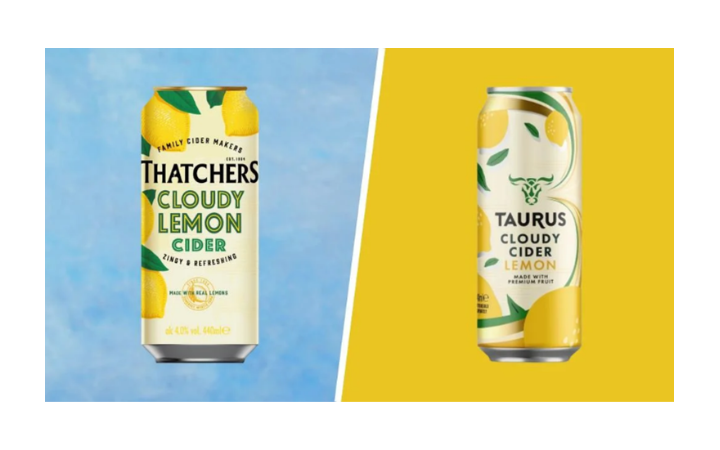
Thatcher’s was initially unsuccessful in its claim before the High Court, although this was unanimously overturned before the Court of Appeal. The Court of Appeal concluded that Aldi was able to achieve substantial sales of its cloudy lemon cider in a short period of time without spending a penny on promoting it. The court did not find a likelihood of confusion, rather, the issue was with Aldi’s piggybacking on Thatcher’s brand reputation.
Whilst this decision does not depart from established case law, the fact that the Court of Appeal considered the matter to be a relatively clear-cut case of unfair advantage can give brand owners confidence that robust trade mark protection can stop look-alike infringements.
The decision reinforces that, in lookalike disputes brought under section 10(3), the real battleground is not confusion but unfair exploitation of reputation.
Crucially, this outcome was strengthened by the scope of Thatcher’s trade mark protection. Had the registered rights only covered the name or logo, it is unlikely that the Court would have found the necessary “mental link” between the products. The case therefore demonstrates that, where the right registrations exist (and reputation can be established), trade mark law can be a powerful tool against dupes. Without such registrations, brand owners may find themselves confined to the more difficult and expensive route of passing off.
We explored the Court of Appeal’s reasoning in more detail in our previous article.
Practical steps to prevent and address dupes
- Think beyond the obvious when it comes to protecting your IP. Dupes try to avoid detection by using entirely different names, while replicating the original product’s appearance, messaging and functionality. To combat this, brands must now consider protecting a broader range of IP assets. For example, it is possible to protect your product’s get-up i.e. how it appears without your trade mark or any logos. Post-Thatcher’s, brand owners should strongly consider registering trade marks for the overall appearance of distinctive packaging or labelling, particularly where a hero beauty product is likely to be ‘duped’. Such registrations may act as a significantly stronger deterrent to overly close benchmarking practices than was previously assumed, and can substantially strengthen enforcement options.
- Keeping your finger on the pulse by regularly monitoring the market is key to catching potential dupes early. For example, regularly check social media, in particular the hashtag #dupe or #dupe followed by your brand name.
- Speed is critical when lookalikes emerge, as allowing brand imitations to proliferate without intervention can make enforcement over time difficult and expensive.
- Enhance your monitoring capabilities by introducing a trade mark watching or online monitoring service, that can quickly identify potential infringements and automatically handle online takedowns on your behalf.
- Educate on authenticity; highlight to your customer what it is that makes your product original and why they should avoid dupes, ultimately sending a clear message to any potential copycats.
The growth of the dupe market reinforces a clear message: registration strategy matters. Brand owners should consider reviewing whether their most distinctive products are protected not only by name, but also by appearance. In the post-Thatcher’s landscape, those registrations may prove decisive.
If you would like to discuss your trade mark and design strategy in light of these developments, please contact our team.


