An overview of GUI patenting at the EPO: 2026 update on inventive step and AI

Barry Moore
Following my recent presentation at the EPO's Search and Examination Matters 2026 conference, this updated briefing reflects the latest developments, statistical trends, and the specific challenges and opportunities presented by AI-enhanced GUIs.
A year ago, in March 2025, I provided an overview of the requirements for patenting Graphical User Interfaces (GUIs) at the European Patent Office (EPO).
Since then, the landscape has continued to evolve, particularly with the rapid integration of Artificial Intelligence (AI).
While the fundamental principles of assessing inventive step remain consistent, the growing role of AI demands a more nuanced approach to demonstrating a technical contribution.
The enduring principles: Technical contribution remains key
The core of the EPO's assessment for GUI-related inventions has not changed. The consistent application of the problem-solution approach means that patentability still hinges on two fundamental questions:
- Does the GUI solve a technical problem?
- Does it involve technical considerations that go beyond mere user preference or aesthetic design.
As established in landmark case law, such as COMVIK (T 0641/00), features of an invention are assessed by whether they contribute to solving a technical problem. For GUIs, this means distinguishing between features that offer genuine technical innovation and those that are purely decorative, subjective, or relate to non-technical business methods. The main hurdle remains demonstrating an inventive step under Art 56 EPC.
- Presentation of Information (Output): How information is displayed must serve a technical purpose. For example, a specific layout that enables a surgeon to position an implant more precisely (as noted in T 0336/14) has a technical effect. In contrast, simply colour-coding data based on user preference does not.
- Mechanisms for User Input: Input features are often more likely to have a technical character because they require compatibility with a machine's predetermined protocols.
Innovations like predictive text input or gesture recognition that allow for faster, more accurate input or reduce the device's processing load are considered technical.
The new frontier: How does AI impact inventive step in GUIs?
The central question now facing applicants is: Does the incorporation of AI really change anything? The answer is yes, but only if the AI's contribution is correctly framed.
The AI model itself is typically viewed as a non-technical mathematical method. Therefore, the technical contribution must come from its specific application to solve a technical problem via the GUI. Simply using AI to enhance user experience in a subjective way—for instance, to arrange icons or change colours based on predicted user preferences—will not be considered a technical contribution.
However, if the AI is used to improve the internal functioning of the computer or to control a technical process, it can form the basis for an inventive step. A clear example is an AI system that analyses user interaction to predict and pre-render data, thereby reducing CPU usage and latency. This is a tangible technical effect on the system's performance.
Key principles for patentable AI-enhanced GUI claims
Based on the EPO's approach, applicants seeking to patent AI-enhanced GUIs should focus on the following key principles:
- Focus on a Specific Technical Purpose: The AI-driven GUI must serve a clear technical goal. This could be enhancing the quality of a displayed image, improving the efficiency of data retrieval, or controlling an external technical system. A GUI that assists a user in performing a technical task through a guided human-machine interaction is explicitly mentioned in the EPO Guidelines as having technical character.
- Demonstrate a Credible Technical Effect: The effect must be objective, credible, and causally linked to the claimed features. If the presentation of information enables a user to perform a technical task more efficiently or accurately (e.g., medical image analysis), it is considered technical. An effect that is merely more aesthetically pleasing is not.
- Highlight the "How" over the "What": Claims should focus on how the GUI and the underlying AI algorithm achieve a technical result, not just what the result is. Instead of claiming a GUI that displays "more relevant" information, the claim should specify the technical means, such as a specific data processing method that reduces computational resources.
- Link to a Technical System: The GUI's functionality should ideally be linked to the control or operation of a technical system, such as industrial machinery, a medical device, or the internal workings of the computer itself.
Practical examples of patentable AI-enhanced GUIs
To illustrate these principles, consider these examples:
AI-powered image retrieval
A method where a trained neural network identifies semantically related images from a database. It then generates low-resolution thumbnails and arranges them in a grid based on a dimensionality reduction of their feature vectors, clustering similar images together. This actively guides the user, facilitating a more intuitive and efficient browsing experience, which is a technical solution to the problem of retrieving images from a large database (inspired by T 0643/00).
AI-assisted control of a robotic arm
A system where a user indicates a target object on a real-time video feed. A convolutional neural network (CNN) determines the object's 3D coordinates, and a reinforcement learning model generates a collision-free trajectory for the robotic arm. Here, the AI and GUI are directly controlling a physical object, which is a clear technical application.
AI-enhanced medical image analysis
A method where a user selects a region of interest on a medical image. A generative adversarial network (GAN) processes this region to generate a synthetic image highlighting potential anomalies not readily visible to the human eye. This provides a clear technical contribution by revealing hidden information, credibly assisting a medical professional in the technical task of diagnosis.
Statistical trends: A look at the EPO's activity (2019-2025)
The latest data reveals clear trends in this space:
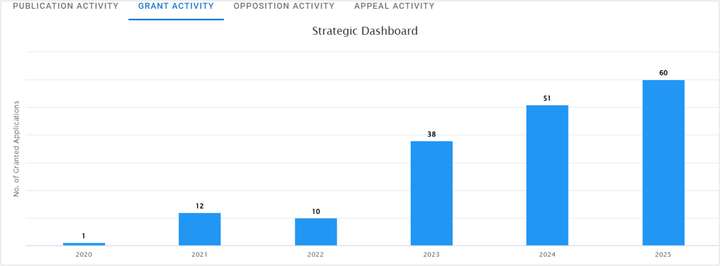
GUI applications are growing
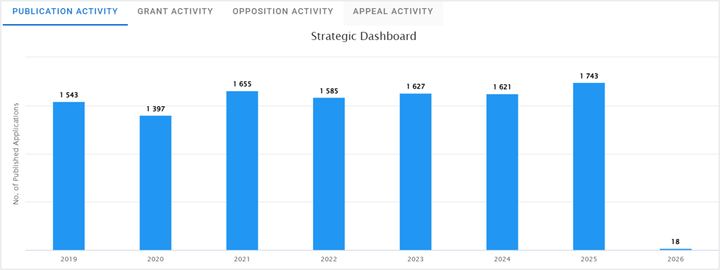
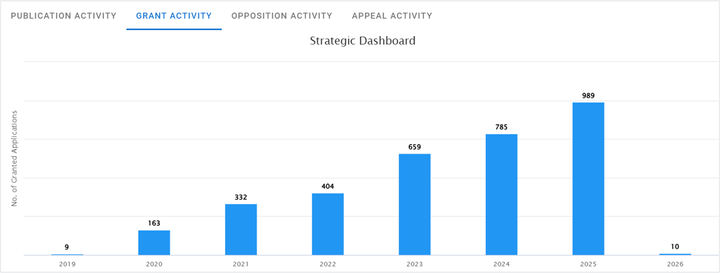
Both publication and grant numbers for general GUI cases have seen a steady increase, with over 1,700 applications published and nearly 1,000 granted in 2025 alone.
GUI & AI is an emerging field
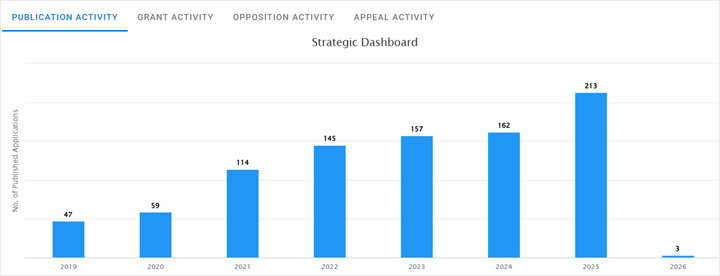
While the numbers are smaller, the growth is significant. Published applications for GUIs involving AI have quadrupled from 2019 to 2025. Grant numbers have also risen sharply, indicating the EPO is awarding patents in this area when the criteria are met.
Appeals remain challenging
The path to grant is not easy. Data shows that when an examining division refuses an application, the appeal is rejected in over 80% of cases. This stark figure underscores the importance of drafting a robust patent application that clearly demonstrates a technical contribution from the outset.
Conclusion and takeaways
Patenting GUIs at the EPO, especially those enhanced with AI, requires a strategic focus on demonstrating a clear and credible technical contribution. While the core legal framework is unchanged, the burden is on the applicant to show that the invention, assessed as a whole, is more than just a clever algorithm or an attractive interface.
When drafting claims, applicants should:
Do:
- Link AI outputs and GUI behaviour to a system-level effect (e.g., reduced memory usage).
- Describe what the computer does differently to achieve the technical effect.
- Claim concrete interaction mechanisms, not abstract screen layouts.
Avoid:
- Relying on "improved user experience" as the sole benefit.
- Focusing claims only on what is displayed.
- Describing AI merely as "an algorithm" or "a model" without specifying its function in solving a technical problem.
By carefully defining the technical purpose and implementation, and by linking the invention to a technical system or process, applicants can significantly increase their chances of securing a patent for their innovative GUIs in Europe.
If you would like some more information about how to obtain patents for graphical user interfaces specifically, or any aspect of computer-implemented inventions, please contact our team.
Meet the author

About Barry Moore
Related insights
Featured insight

Key themes from the IPO Annual Meeting 2026: AI, accountability and digital designs
- Read article
Patent Box take-up: What has changed since the beginning?
- Read article
The power of strategic partnerships in AI: Key IP considerations
- Read article
Patent Box relief passes £2 billion as take-up continues to grow
- Read article
Carry-over auxiliary requests in EPO appeals: Why early procedural planning can protect commercial value
- Read article
Filed, published & granted patents: What’s the difference?

Murgitroyd is a leading intellectual property firm supporting innovative businesses across a wide range of sectors. From patents and trade marks to designs, copyright, and IP strategy, their expertise extends beyond legal protection to helping organisations maximise the value of their ideas. Working across industries such as life sciences, engineering, technology, and creative sectors, Murgitroyd combines technical insight with commercial understanding to deliver tailored, forward-thinking solutions.


